Free template · Word and PDF
Attendance log for write-ups, with a filled-in example
An attendance write-up rests on dates, not memory. This log keeps them: each late arrival and absence as it happens, the notice they gave, whether it counts, and every talk and step taken. You get two forms from the Firm & Fair Paper Trail, each in Word and PDF with a filled-in example: the Attendance Log, and the Written Warning for the write-up itself. Fill in a line of the log the same day; the warning comes when the log shows the pattern (how to fill it in).
What’s on it
- The basics: the business, the employee’s name and position, and their usual schedule.
- The attendance policy: its name, the page, and the date they signed it.
- A line for each late arrival or absence: the date, the scheduled start, when they clocked in or called, how late they were or that they were absent, the notice they gave (when and how), whether it counts, notes, and your initials.
- Counted? Write what happened, not why you think it happened. Approved time off is a “No”, and so is any absence the law may protect, such as family or other protected leave, your state’s or city’s paid leave, jury duty or military service. If you aren’t sure, ask before you count it. Personal details stay off the log.
- Talks and steps taken: the date, the step (coaching, documented conversation, written warning), the form used, and who did it.
- Kept by: the person who keeps the log.
See it before you download it
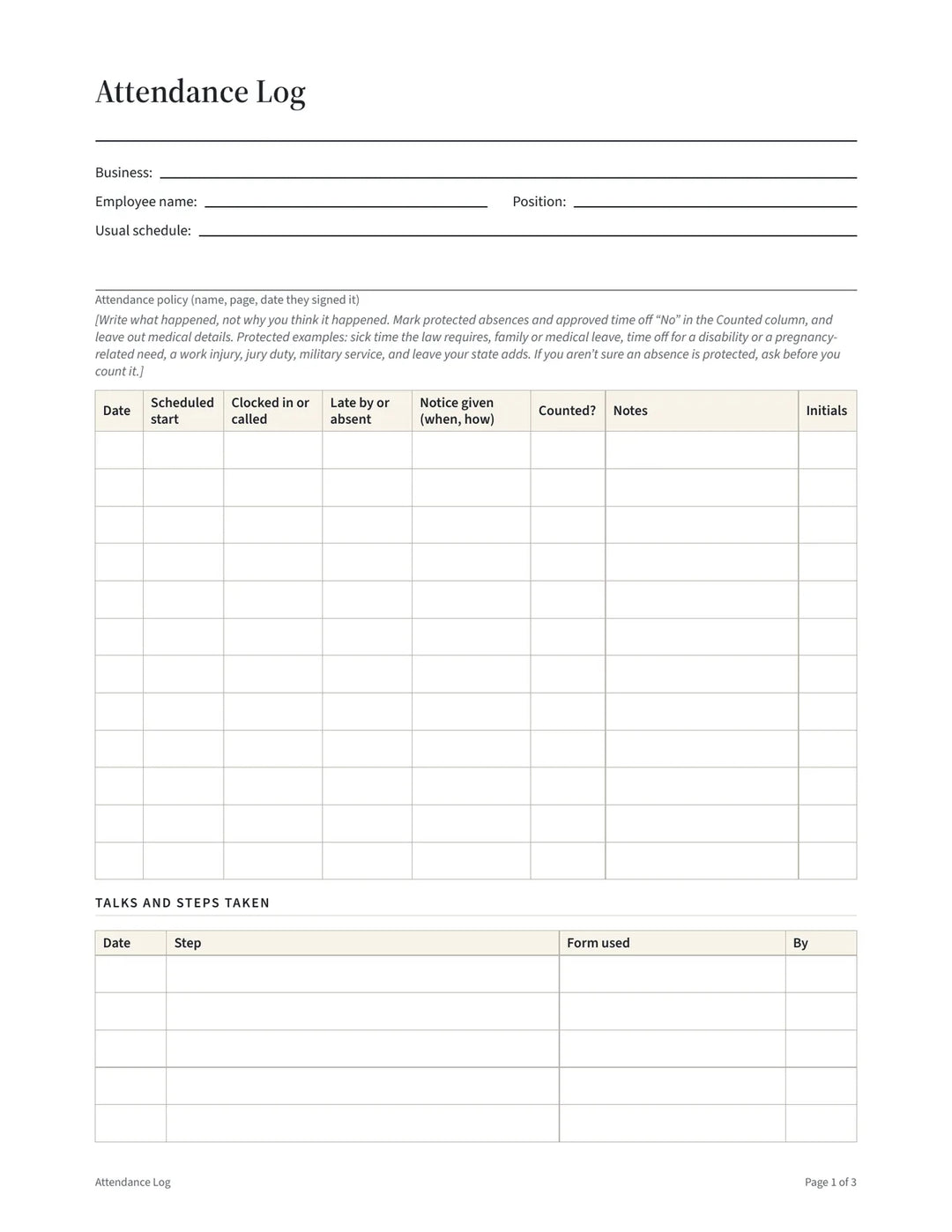
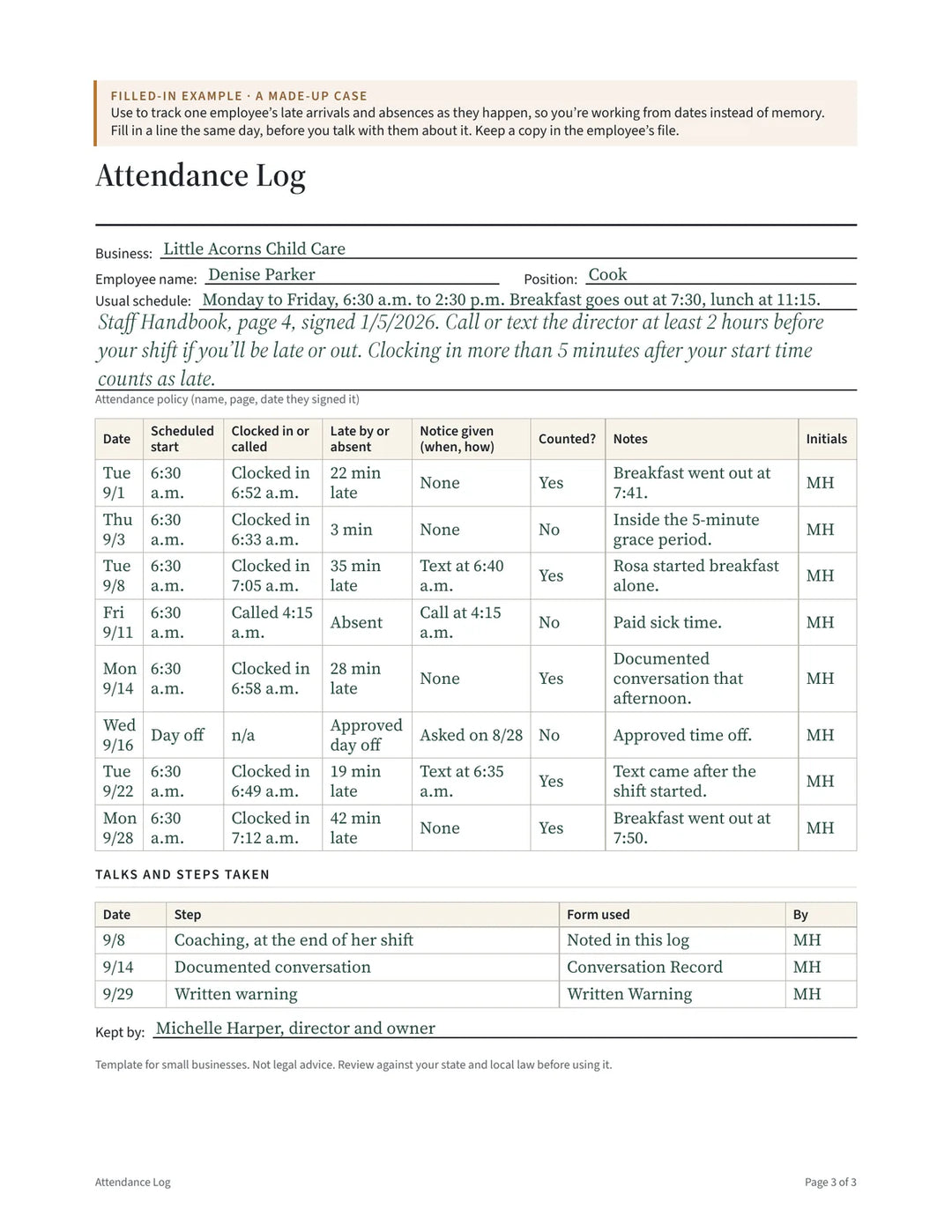
Real pages from the file. The example is a made-up case. Template for small businesses. Not legal advice. Review against your state and local law before using it.
How to use it
- Start a line at the first late arrival, the same day, before you talk with them about it: the clock-in time, any call or text, and their reason in their words. Screenshot texts both ways and save them.
- Keep one for anyone who starts running late. Same rules, same paper. If you’ve let someone else slide, fix that first, or the write-up becomes proof that the rule bends.
- Run the Check below before anything goes on paper. On attendance, look hardest at two lines: have they told you about something personal that may need time off or a change at work, and have they asked for a schedule change for that reason? Any yes, stop and get advice. Write only that they raised it and that you’re checking.
- Then the steps, in order: a coaching talk, the documented conversation on the verbal warning template, and the written warning on the employee write-up form, with “Attendance” checked. Log each one under “Talks and steps taken.” The talk itself, word for word: what to say to an employee who’s always late.
- Bring the log to every talk. Dates and clock-in times are much harder to argue with than “you’re always late.” Keep a copy in their file. Any details they give you about a protected absence go in a separate confidential folder, apart from their regular file.
Before any write-up or firing: the Check
Trouble often starts with something reasonable done at the wrong moment: a write-up the week after a complaint, a firing right after a request for time off. The Playbook has you run the Check first.
Before you act, has any of this happened?
- They complained about something at work recently.
- They asked for time off, or for a change in how or when they work.
- They told you about something personal that may need time off or a change at work.
- There’s a workers’ comp claim.
- They were a witness in someone else’s complaint.
- They’ve talked with coworkers about pay or working conditions.
- The timing could look like payback.
- It’s a layoff, and you’re choosing someone 40 or older.
- Someone could believe the real reason is a different one.
Any yes: stop, and get advice before the next step.
A tip from the Playbook: many business insurance policies include an HR or legal helpline. Find out whether yours does now, before you need it.

The Firm & Fair Playbook
This form is half of it. The other half is the conversation: what to say when they push back, what never to say, and when to stop and get advice first.
32 conversations, word for word, 18 templates with a filled-in example each, and Quick Cards for your phone.
$97 once. Instant download. 30-day refund, and you keep the files.
See what’s insideQuestions owners ask
How do you write up an employee for attendance?
From the log, not from memory. Pull the dates, the scheduled starts, the clock-in times and the notice they gave, leave out anything that doesn’t count, and run the Check. The write-up itself goes on the employee write-up form with “Attendance” checked: what happened, the rule and when they got it, the earlier steps with their dates, what has to change, and what happens if it continues. What to say in the meeting: how to write up an employee.
Which absences shouldn’t count against an employee?
Approved time off, and any absence the law may protect: family or other protected leave, your state’s or city’s paid leave rules, jury duty, military service, and leave your state adds. Mark those “No” in the Counted column. If they tell you about something personal that may need time off or a change at work, write only that they raised it, leave the day off the count, and get advice. If you aren’t sure about an absence, ask before you count it.
Related
- Late again Late again, for the fourth time: the talk with the clock-in times in hand.
- Employee write-up form The written warning form, in Word and PDF, with a filled-in example.
- Verbal warning template The record of a documented conversation, in Word and PDF, with a filled-in example.
- Final written warning template The last step before the end of the job, in Word and PDF, with a filled-in example.
Free
Get the attendance log
The Word file to fill in and the PDF, each with the blank form and a filled-in example. We’ll also send Script 1 from the Playbook, the complete first conversation, word for word.
Not legal advice. Practical wording and process guidance for business owners, written for workplaces in the United States. For a specific situation, talk to an employment attorney licensed in your state.