Free template · Word and PDF
Employee incident report for conduct problems, with a filled-in example
An incident report is the record you write the same day something happens that you may need to remember exactly later: an argument or threat, damage, a customer complaint, missing money or property, or a close call on a safety rule. It’s the Incident Report from the Firm & Fair Paper Trail, in Word and PDF, with a filled-in example. Facts only, with what you saw yourself kept apart from what someone told you.
What’s on it
- The basics: the business, the date, time and place of the incident, and the date and time you’re writing the report.
- The type: damage, a customer complaint, an argument or threat, missing money or property, a near miss, or other.
- The people involved, with their jobs. Someone who only reported it or saw it goes on the confidential page instead.
- What happened, in order: times, what people did, and exact words in quotes. Start each part with “I saw” or “Told to me by” and what the confidential page calls them (“the person who reported it,” “Witness 1”), not their name.
- Photos, video, documents: what there is, who took it, and where it’s saved.
- What was done right away: area made safe, people separated, someone sent home, police or client called.
- Next steps: look into it (on the Investigation Interview Notes), talk with the employee, an insurance claim, repair or replace, or none. Then your name, your signature and the date.
- The confidential page: who reported it and each witness, with their job, how to reach them, and when and how they told you. It stays in your incident file, never goes in anyone’s personnel file, and is never shown to the people involved; only your attorney, your insurer, or the police, an agency or a court that asks for it may see it.
See it before you download it
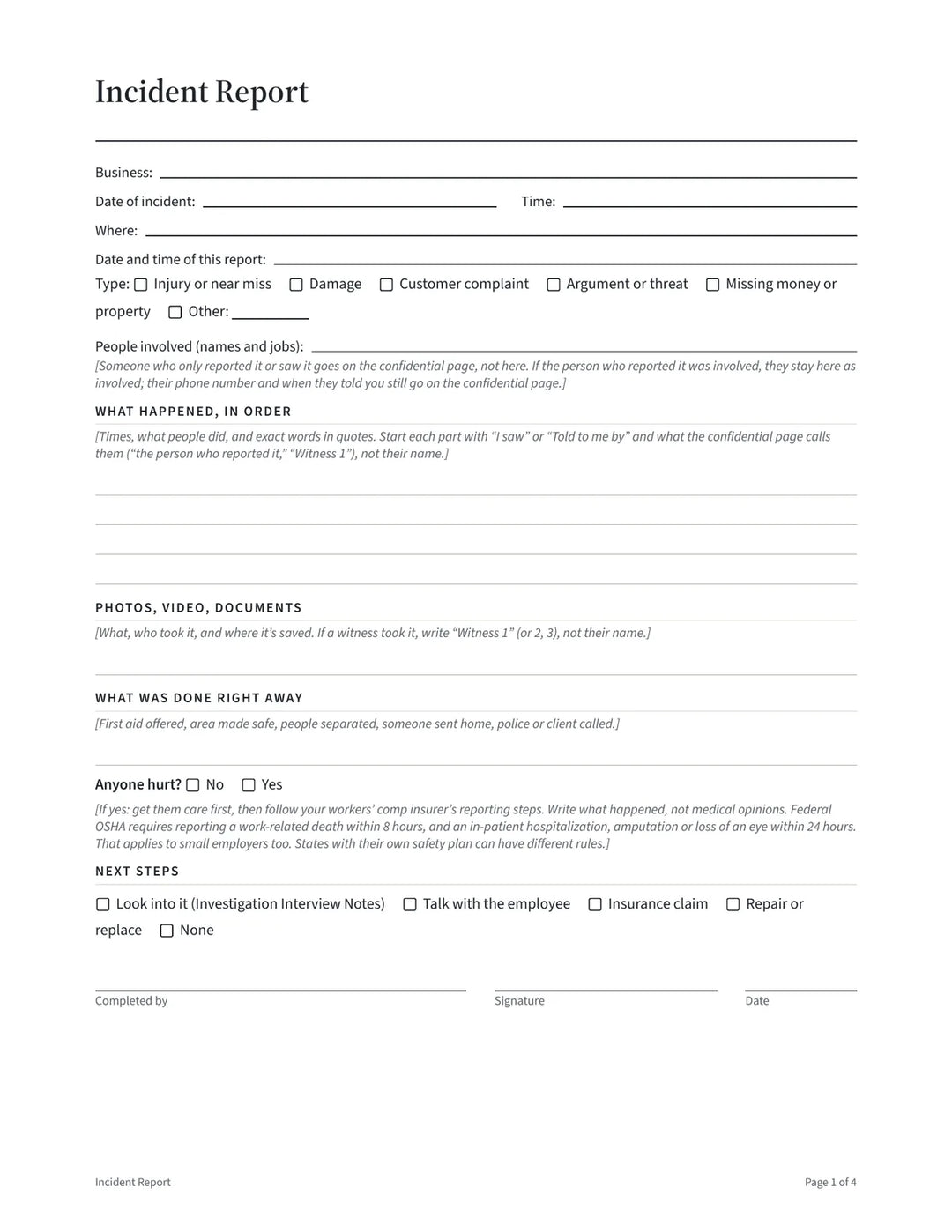
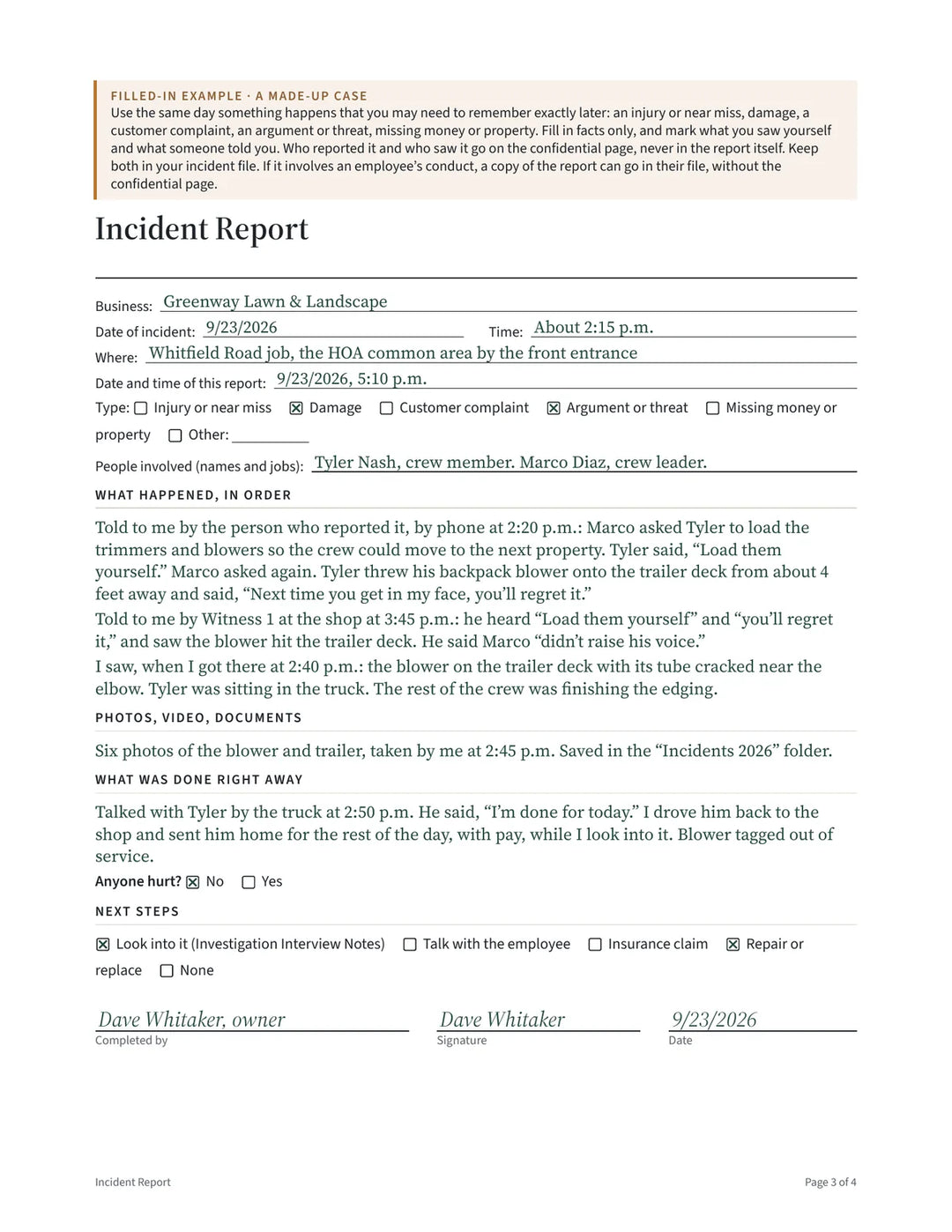
Real pages from the file. The example is a made-up case. Template for small businesses. Not legal advice. Review against your state and local law before using it.
How to use it
- Write it the same day, before you go home. Memory is generous to whoever’s doing the remembering.
- Exact words, not labels. Write what a camera would have caught, with the times. A threat goes down word for word: “Next time you get in my face, you’ll regret it,” not “he threatened Marco.” With missing money or stock: the dates, the amounts, who worked, and what the register reports show. No guesses about who.
- Keep what you saw apart from what you were told, and get each witness’s account in their own words. They can write or confirm it on a witness statement. Never tell the people involved who reported it or who backed it up: their names stay on the confidential page, and keeping them clear of payback is your job.
- Don’t decide in the heat of the moment. If it’s serious and you can’t check it today, send the person home with pay while you look into it: suspension pending investigation. If you suspect violence, theft or a serious safety breach and the facts aren’t nailed down yet, stop and get advice, and don’t accuse anyone until they are.
- If an employee reports a hazard, or brings you a complaint about harassment, discrimination, pay or retaliation, follow the complaint protocol: thank them, fix anything dangerous first, and make sure nobody punishes them for raising it.
- Before any write-up that follows, run the Check below. For a safety rule ignored, what to say to the employee and the written warning that usually comes next: safety violation write-up.
- Sign and date it, then file both pages in your incident file. If it involves an employee’s conduct, a copy of the report can go in their file, without the confidential page.
Before any write-up or firing: the Check
Trouble often starts with something reasonable done at the wrong moment: a write-up the week after a complaint, a firing right after a request for time off. The Playbook has you run the Check first.
Before you act, has any of this happened?
- They complained about something at work recently.
- They asked for time off, or for a change in how or when they work.
- They told you about something personal that may need time off or a change at work.
- There’s a workers’ comp claim.
- They were a witness in someone else’s complaint.
- They’ve talked with coworkers about pay or working conditions.
- The timing could look like payback.
- It’s a layoff, and you’re choosing someone 40 or older.
- Someone could believe the real reason is a different one.
Any yes: stop, and get advice before the next step.
A tip from the Playbook: many business insurance policies include an HR or legal helpline. Find out whether yours does now, before you need it.

The Firm & Fair Playbook
This form is half of it. The other half is the conversation: what to say when they push back, what never to say, and when to stop and get advice first.
32 conversations, word for word, 18 templates with a filled-in example each, and Quick Cards for your phone.
$97 once. Instant download. 30-day refund, and you keep the files.
See what’s insideQuestions owners ask
What should an employee incident report include?
The date, time and place; when you wrote it; the people involved; what happened, in order, with exact words in quotes; any photos, video or documents and where they’re saved; what you did right away; and the next steps. Mark each part “I saw” or “Told to me by”, so what you saw yourself stays apart from what someone told you. Who reported it and who saw it, with how to reach them, go on a separate confidential page, and the report calls them “the person who reported it” or “Witness 1”.
How do you write an incident report about an employee’s behavior?
Like a camera would: what they did and said, with times, and nothing about who they are. “Said ‘Load them yourself’ and threw his blower onto the trailer deck” is a record. “Bad attitude” is a label, and people argue with labels. Quote threats exactly. Your conclusions come later, after you’ve heard every side, on the investigation report.
Should an incident report go in the employee’s file?
Yes, if it involves their conduct: a copy of the report, without the confidential page. The confidential page names who reported it and who saw it, so it stays in your incident file and never goes in anyone’s personnel file. If someone tells you something specific about a coworker, write their account on the Investigation Interview Notes and keep it out of anyone’s personnel file until you’ve gotten advice. Complaint and investigation papers go in one folder of their own, shared only with the people who need them.
When should you write an incident report?
The same day something happens that you may need to remember exactly later: damage, a customer complaint, an argument or threat, missing money or property. A safety rule ignored gets one too: treat it as the close call it was.
Related
- A safety rule ignored Caught breaking the same safety rule twice, so today’s talk leads to a write-up.
- Employee witness statement form The form a coworker fills in, in their own words, about what they saw or heard.
- Workplace investigation report template The record of what you looked into, who you talked to, what you found and decided.
- Employee write-up form The written warning form, in Word and PDF, with a filled-in example.
Free
Get the employee incident report
The Word file to fill in and the PDF, each with the blank form and a filled-in example. We’ll also send Script 1 from the Playbook, the complete first conversation, word for word.
Not legal advice. Practical wording and process guidance for business owners, written for workplaces in the United States. For a specific situation, talk to an employment attorney licensed in your state.