Free template · Word and PDF
Performance improvement plan template, with a filled-in example
A performance improvement plan spells out exactly what “better” means: two to four goals you can count, real support, weekly check-ins and an end date. Use it for someone you want to keep, when their work isn’t meeting a clear standard. This one is from the Firm & Fair Paper Trail, in Word and PDF, with notes on what to write and a filled-in example.
What’s on it
- The basics: the business, the employee’s name and position, their manager, and when the plan starts and ends. Long enough to show real change, usually 30 to 60 days.
- Where things stand: the standard, what’s actually happening, with numbers and dates, and the earlier talks about it.
- Goals: two to four, each one you can count or check, in a table: the goal, how you’ll measure it, the target, and by when. Don’t change them mid-plan unless you write down why and you both sign.
- Support from us: what you’ll actually do. Training, time, tools, someone to check the work, clearer instructions.
- Check-ins: the day and time, the final review date, and a row for each one: the date, whether they’re on track, notes, and initials.
- If the goals are met: the plan closes, and you write how you’ll keep an eye on it afterward, for example a monthly check for three months.
- If they aren’t met by the end date: said plainly, for example “Your employment will end.”
- The signatures: the manager’s, and the employee’s, which acknowledges receipt, not agreement. A box for “declined to sign”, with a witness, and room for their comments.
See it before you download it
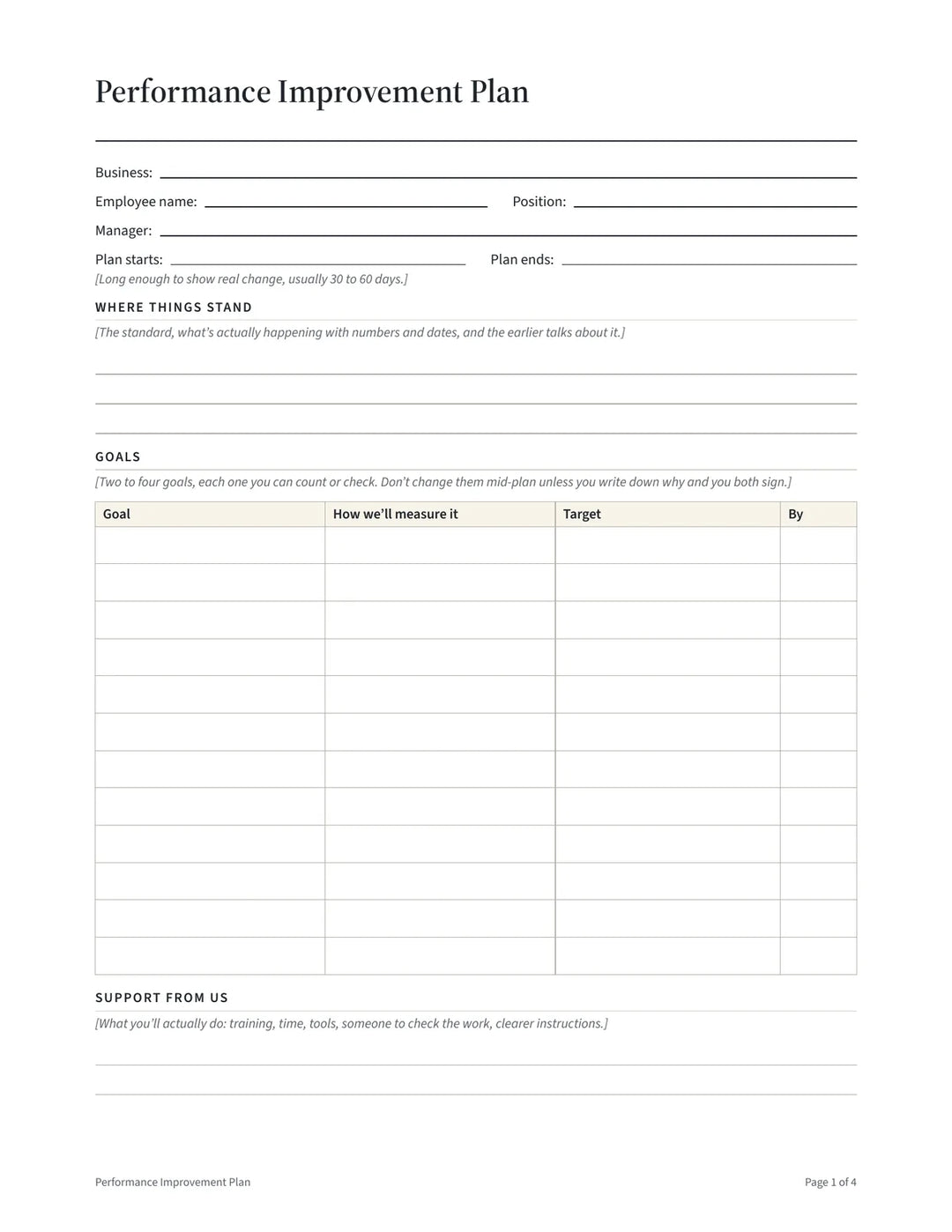
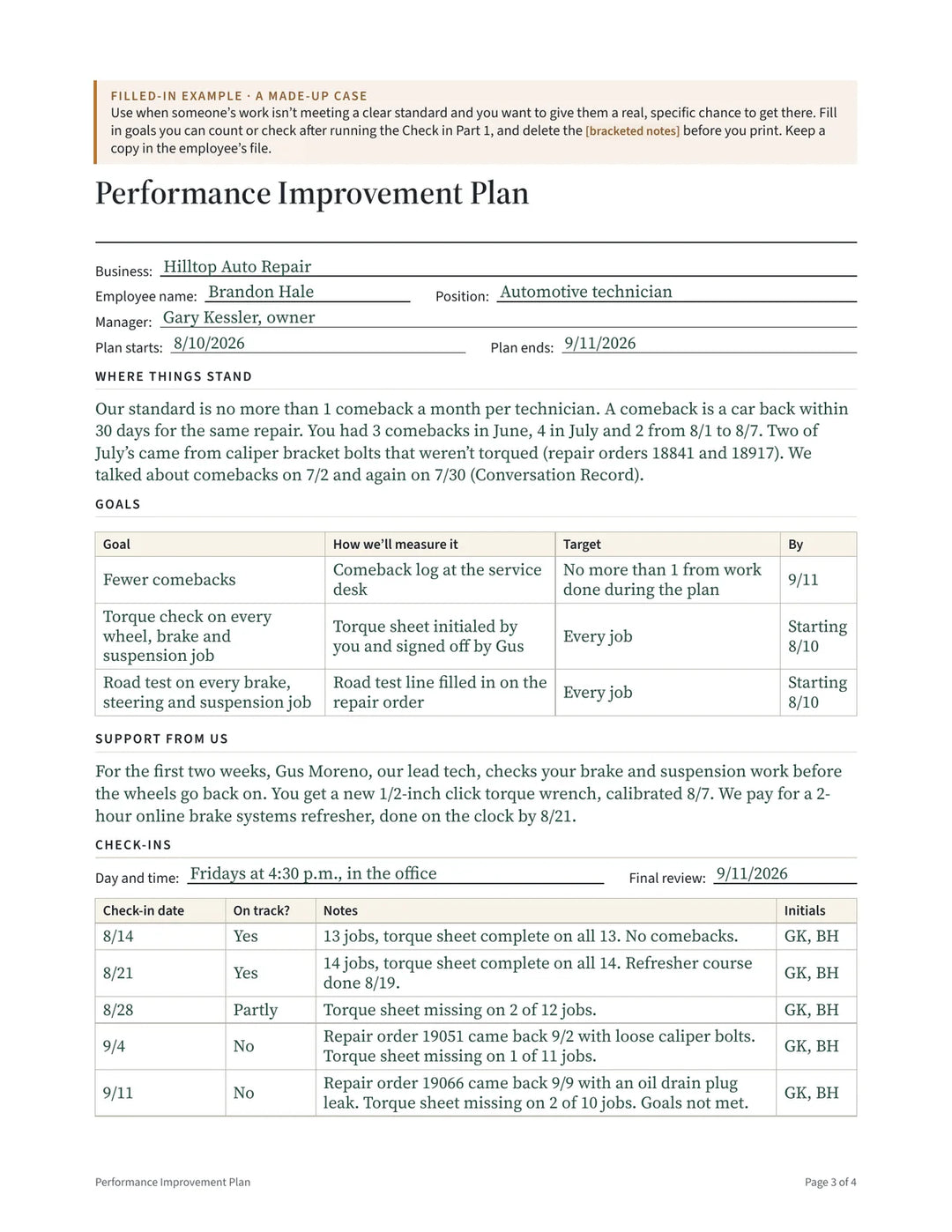
Real pages from the file. The example is a made-up case. Template for small businesses. Not legal advice. Review against your state and local law before using it.
How to use it
- Make sure a plan fits. A plan is for someone you want to keep. If you’ve already decided they’re done, a plan you expect to fail is a pretext, and it reads like one later: talk to your advisor about ending it instead. And check whether the job grew. If it has outgrown one person, a plan won’t fix that.
- Run the Check below before you start. If they tell you about something personal that may need time off or a change at work, now or during the plan, pause the plan and get advice. Don’t ask what it is, and don’t make a deal on the spot.
- Write it before the meeting, with targets you can count and support with names and days. “Be more on top of things” isn’t a target. If you can’t measure it on the last day, it doesn’t belong in the plan.
- Go through it in private, door closed, no witness this time: you want them talking. What to say, and what to say when they ask if this is the first step to firing them: how to put an employee on a PIP.
- Ask them to sign, for receipt, not agreement. If they won’t, write “declined to sign” and date it. Either way, they get a copy, and one goes in their file.
- After every check-in, write three lines: the date, where they stand on each goal, and anything either of you agreed to change. Those notes are what make the last day fair, whichever way it goes.
Before any write-up or firing: the Check
Trouble often starts with something reasonable done at the wrong moment: a write-up the week after a complaint, a firing right after a request for time off. The Playbook has you run the Check first.
Before you act, has any of this happened?
- They complained about something at work recently.
- They asked for time off, or for a change in how or when they work.
- They told you about something personal that may need time off or a change at work.
- There’s a workers’ comp claim.
- They were a witness in someone else’s complaint.
- They’ve talked with coworkers about pay or working conditions.
- The timing could look like payback.
- It’s a layoff, and you’re choosing someone 40 or older.
- Someone could believe the real reason is a different one.
Any yes: stop, and get advice before the next step.
A tip from the Playbook: many business insurance policies include an HR or legal helpline. Find out whether yours does now, before you need it.

The Firm & Fair Playbook
This form is half of it. The other half is the conversation: what to say when they push back, what never to say, and when to stop and get advice first.
32 conversations, word for word, 18 templates with a filled-in example each, and Quick Cards for your phone.
$97 once. Instant download. 30-day refund, and you keep the files.
See what’s insideQuestions owners ask
How long should a performance improvement plan last?
Long enough to show real change, usually 30 to 60 days: long enough to see the numbers move, with a check-in every week. The filled-in example runs about a month, from 8/10 to 9/11, and the Playbook’s script runs sixty days. Either way, write the end date and the final review on the plan, so the last day is no surprise.
What are good goals for a performance improvement plan?
Two to four, each one you can count or check, with a target and a date. From the Playbook’s script: every invoice out within two business days of the event, and payroll inputs in by Monday noon. From the filled-in example: no more than one comeback from work done during the plan, and a torque check on every wheel, brake and suspension job. “Be more on top of things” isn’t a goal. If you can’t measure it on the last day, it doesn’t belong in the plan.
Is a PIP just a step toward firing someone?
It shouldn’t be. A plan is for someone you want to keep. If you’ve already decided they’re done, don’t put them through sixty days of theater: a plan you expect to fail is a pretext, and it reads like one later. A real plan says both outcomes plainly. Goals met, it closes. Not met by the end date, the next step is ending the job. Say that on day one, so nobody is surprised.
Related
- Starting a performance plan Targets you can count, real help and weekly check-ins, for someone you want to keep.
- Final written warning template The last step before the end of the job, in Word and PDF, with a filled-in example.
- Employee write-up form The written warning form, in Word and PDF, with a filled-in example.
- Termination letter template Performance, conduct or position eliminated, each in Word and PDF with an example.
Free
Get the performance improvement plan template
The Word file to fill in and the PDF, each with the blank form and a filled-in example. We’ll also send Script 1 from the Playbook, the complete first conversation, word for word.
Not legal advice. Practical wording and process guidance for business owners, written for workplaces in the United States. For a specific situation, talk to an employment attorney licensed in your state.